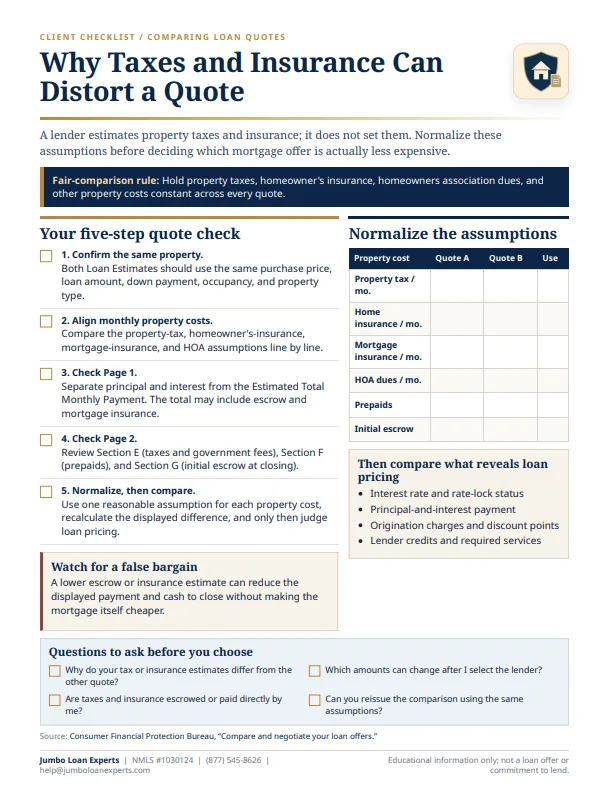
A lender estimates property taxes and insurance; it does not set them. Normalize these assumptions before deciding which mortgage offer is actually less expensive.
The fair-comparison rule
Hold property taxes, homeowner's insurance, homeowners association dues, and other property costs constant across every quote.
Your five-step quote check
- 1.Confirm the same property: Both Loan Estimates should use the same purchase price, loan amount, down payment, occupancy, and property type.
- 2.Align monthly property costs: Compare the property-tax, homeowner's-insurance, mortgage-insurance, and HOA assumptions line by line.
- 3.Check Page 1: Separate principal and interest from the Estimated Total Monthly Payment. The total may include escrow and mortgage insurance.
- 4.Check Page 2: Review Section E (taxes and government fees), Section F (prepaids), and Section G (initial escrow at closing).
- 5.Normalize, then compare: Use one reasonable assumption for each property cost, recalculate the displayed difference, and only then judge loan pricing.
Watch for a false bargain
A lower escrow or insurance estimate can reduce the displayed payment and cash to close without making the mortgage itself cheaper.
Normalize the assumptions
For Quote A and Quote B, line up each property cost and pick one figure to use for both: property tax per month, home insurance per month, mortgage insurance per month, HOA dues per month, prepaids, and initial escrow.
Then compare what reveals loan pricing:
- Interest rate and rate-lock status
- Principal-and-interest payment
- Origination charges and discount points
- Lender credits and required services
Questions to ask before you choose
- Why do your tax or insurance estimates differ from the other quote?
- Are taxes and insurance escrowed or paid directly by me?
- Which amounts can change after I select the lender?
- Can you reissue the comparison using the same assumptions?