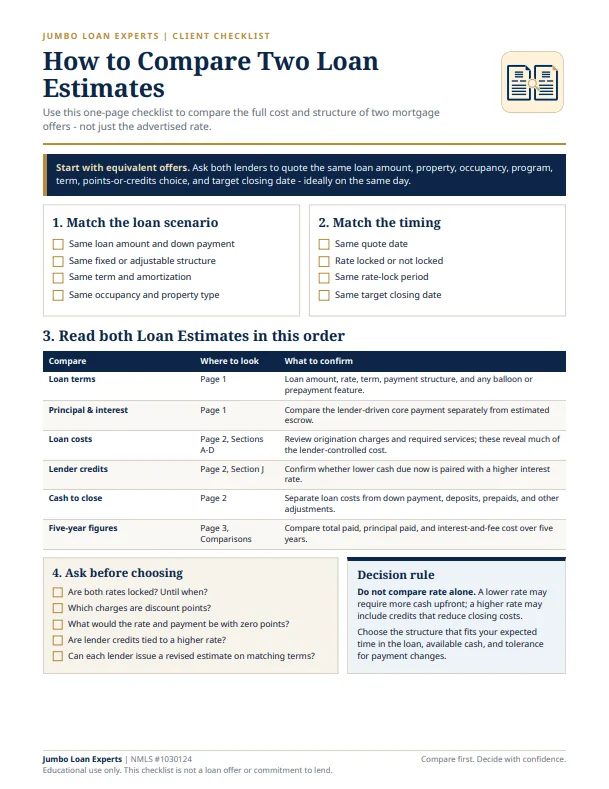
Use this checklist to compare the full cost and structure of two mortgage offers, not just the advertised rate.
Start with equivalent offers
Ask both lenders to quote the same loan amount, property, occupancy, program, term, points-or-credits choice, and target closing date, ideally on the same day.
Match the loan scenario
- Same loan amount and down payment
- Same fixed or adjustable structure
- Same term and amortization
- Same occupancy and property type
Match the timing
- Same quote date
- Rate locked or not locked
- Same rate-lock period
- Same target closing date
Read both Loan Estimates in this order
| Compare | Where to look | What to confirm |
|---|---|---|
| Loan terms | Page 1 | Loan amount, rate, term, payment structure, and any balloon or prepayment feature. |
| Principal & interest | Page 1 | Compare the lender-driven core payment separately from estimated escrow. |
| Loan costs | Page 2, Sections A-D | Review origination charges and required services; these reveal much of the lender-controlled cost. |
| Lender credits | Page 2, Section J | Confirm whether lower cash due now is paired with a higher interest rate. |
| Cash to close | Page 2 | Separate loan costs from down payment, deposits, prepaids, and other adjustments. |
| Five-year figures | Page 3, Comparisons | Compare total paid, principal paid, and interest-and-fee cost over five years. |
Ask before choosing
- Are both rates locked? Until when?
- Which charges are discount points?
- What would the rate and payment be with zero points?
- Are lender credits tied to a higher rate?
- Can each lender issue a revised estimate on matching terms?
Decision rule
Do not compare rate alone. A lower rate may require more cash upfront; a higher rate may include credits that reduce closing costs. Choose the structure that fits your expected time in the loan, available cash, and tolerance for payment changes.